Thursday, July 9, 2009

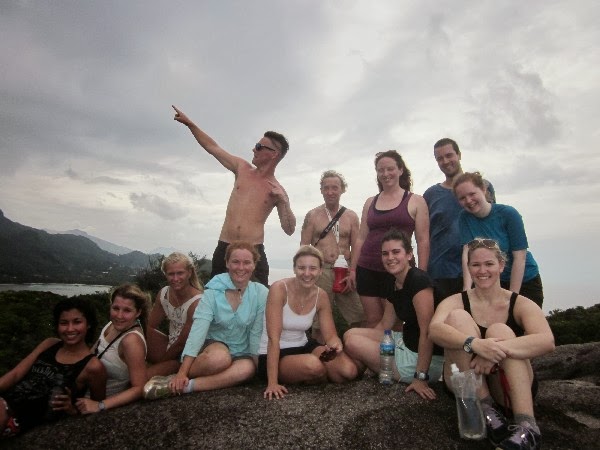
Jump for joy with GVI Seychelles


The South East Monson has arrived on time with cooling winds and refreshing rain. Here on base we moved on to the second week after a well deserved weekend off, giving volunteers and staff time to catch there breath and look around, noticing not for the first probably, that we are privileged to live in one of the most beautiful places on earth.


Then on Monday back to work. We have been busy learning about the marine environment, fish, turtles, whale sharks and Emergency First Response. Yesterday the whole group started with watching a very entertaining EFR video about primary and secondary care. After the theory we had a very intense meeting with, “Michael” the manikin. We practiced how to save his life and administer CPR. After mastering the theory our skills were set to the test as we were split into three groups whilst the staff exposed us to various scenarios.


During lunch we soon discovered the scenarios were not in fact over as we were confronted by another situation - staff members put on a very realistic and later also a very ‘Hollywood’ show of choking on their food. The staff members – Colin, Tom and Pauline were successfully saved and everyone had a good laugh. We are expecting a few more tricks over the next few days….


Wednesday, July 1, 2009

A new start at Cap Ternay


As if we were a shoal of Dog tooth Tuna, all volunteers and staff at GVI Seychelles “school” together for one unique objective: to learn/teach and take care of the Seychelles’ ocean and coral reefs as much as we can. In fact, here at our base in Cap Ternay life functions similarly to life on a coral reef. Like a reef, base is the support system to an amazing and superabundance of life. A symbiotic relationship is established in an almost magical way among the volunteers; we share dorms, the kitchen, dive equipment, food, bathrooms, and of course, duties. Duties are a particularly vital chain that keeps the expedition running at the highest quality possible. Without them and without the Science and Conservation workshops, our conservation program would never be possible. For example, while one duty group is preparing lunch, others can be found studying fish cards, spotting fish underwater, or filling tanks for the next dive. With a simple rotation, together we create a perfect ecosystem where we learn to value the importance of all of our expedition colleagues and that of our personal work at the base. Without any doubt, this is our particular calcareous structure, one that allows us to develop as brilliant fish spotters and continue the process of caring for the Seychelles Coral Reefs.


However, Phase 21 just started; during the next ten weeks this precious Cap Ternay “Reef” will do its best to grow as strong and beautiful as it can. It will turn from a blooming fringing reef to a great mutualistic atoll.


From all the Expedition Members here on base we invite you all to be our special witnesses and we hope you enjoy with us this new and fresh phase at Cap Ternay!


Wednesday, June 17, 2009

Reflection of Seychelles by Shanna Nellis.


The Seychelles are a set of islands untouched by development. When I first came across this project, I literally had to look up Seychelles on a map – I had never heard of the country. It’s a wonderful break to be able to step away from the McDonalds and 7-11’s which have polluted other tropical nations. There are so few hotels they can all be listed in a single book.

People buy their ice cream, bread and eggs from a handful of shops scattered around the islands; but they’re few and far between so most learn to live without anything but bare necessities. This however doesn’t hinder the Creole dish; fruit trees abound and the sea provides, all lending to mouth watering curries, dinners and BBQ’s.


The Creole people are more than willing to share their meals with foreigners in exchange for a conversation. I have learned more from speaking to locals than any textbook could teach me. The friendly taxi driver and local farmer are brimming with stories full of history and opinions.

Spending ten weeks in the Seychelles has spoiled me. I’ve grown used to the sweeping landscapes dotted with granitic cliffs. I’ve grown used to the wall geckos and giant fruit bats perched outside the window. And I’ve grown used to the spectacular diving conditions of 25 meters visibility with hundreds of species of corals and fish.


Volunteering for GVI is a unique opportunity in that it affords one the chance to experience all this and more outside of a catered hotel environment. The camp is run via a series of carefully coordinated schedules. Everyone helps out and everyone is held accountable.

On this project I’ve learned about more than what a marine park is and how to collect data underwater. I’ve learned how to make bread and husk a coconut. I’ve learned how to run a compressor, properly care for my diving kit and how to anchor a boat. In addition to a new set of skills I’m sure I’m not the only one to have learned about trust and responsibility.


Living with, working with and socializing with the same group of people for ten weeks has led to some lifelong bonds of friendship.

It’s not a relaxing holiday, but perseverance pays off and after all the studying, sweat and work I feel as though I’ve gained as much as I gave. If this sounds like a challenge you’re up for; then come experience the many faces of paradise.


Tuesday, June 9, 2009

Goodbye and thank you to Genevieve Gammage.

Genevieve came to us two years ago,in that time she has grown from a girl into a confident woman of substance it has been a pleasure to watch he grow and be a part of the process.We will miss her terribly. I wish you everything Gen and thank you so much for you. (Tim Kirkpatrick, Country Director, GVI Seychelles). Here is Gen's GVI story.


GVI can change your life. A bit of a cliché I know but one that is true for so many people, including myself.

I left the UK in April 2007, heading to GVI Seychelles, the first stop on an ‘around-the-world’ ticket. It turned out to be the first and last stop. I’m still here, two years and three months later, coming to the end of my trip, no longer as a volunteer but as Expedition Manager.


After over two years in the mortgage industry it was time for me to make some big changes in my life. I booked my flight ticket, packed my bags and said a tearful goodbye to my family and friends. As I peered up at the huge granitic cliffs that towered over me as I stepped off the plane in Mahe (Seychelles main island) I knew I had made the right decision. The first three weeks of the expedition were filled with fascinating lectures, coral workshops, training dives and getting to know my fellow volunteers. From cooking for over thirty people to operating a compressor I was never short of new things to learn. I even managed to learn how to dive without bashing my buddy with my fins, something I wasn’t entirely convinced I would ever achieve! I had unbelievable encounters with whale sharks and manta rays and got to hang out with like-minded people all day, I was hooked. I applied for an internship so I could stay for another ten weeks and help to teach the next group everything I had learnt. I still vividly remember the moment that the expedition manager offered me the position, I was overjoyed. I spent the following six months as an intern, during which time I developed my teaching skills, became a PADI Divemaster and had a thousand more mind blowing experiences.


Just before Christmas 2007 I was asked to become a paid staff member, I couldn’t believe that I was going to be paid to do something I loved so much, I felt like the luckiest person in the world. After a brief visit to the UK I returned to develop the community work project with the International School of Seychelles and help the volunteers share their marine knowledge with the children. I held an assembly at the school and was featured in an article in the local paper. In April 2008 I became a PADI Instructor so I could teach the Advanced Open Water and Coral Reef Research Diver courses. I spent a phase at the satellite camp on the beautiful island of Curieuse working alongside the Marine Park Rangers and teaching volunteers to tag turtles.


I was offered the position of Expedition Manager to start in October 2008 and have spent the last nine months working alongside an amazing team of staff who have become some of my closest friends.


When I look back at the me that arrived in the Seychelles in 2007, with next to no knowledge of diving or the marine world, I can barely comprehend the amount of skills and knowledge I’ve gained. I’ve not only learnt about marine life, I’ve also learnt about myself. I will leave here with the knowledge that I can achieve anything if I put my mind to it.

Thank you GVI J


Wednesday, June 3, 2009

Carl Royal lands dream job on Desroche island Seychelles


I thought this week I would introduce you to one of the Seychelles true tropical paradise islands, Desroches. Not many volunteers venture this far out from the main islands, they can be difficult to get too and expensive to stay but for a once in a lifetime experience of a truly pristine environment you will not find better anywhere in the world.

One way to get there as Carl Royal found out is to come to GVI Seychelles for ten weeks then apply for a job there. Carl has just gone to live and work on Desroches for a year. He is working for the Island conservation society of Seychelles, putting all the training he gained at GVI Seychelles into practice. He will be working on baseline studies for the extensive coral reefs as well as erosion and beach profiling studies. To give you an idea of where he is living here are some facts and figures for the island.


Île Desroches or Desroches Island is the main island of the Amirante Islands, part of the Outer Islands of the Seychelles. It is located 230 km southwest of Mahe, the Seychelles' main island. It is 6.2 km long and has a land area of 3.24 km². Along its circumference of 15 km is a beach of fine sand.

Desroches has a population of about 50, a settlement in the middle of the northwestern shore (looking to the lagoon), a small luxury hotel with 20 rooms in the south (Desroches Island Resort), built in 1988 and a paved airstrip 1372 m long in the southern part. There is a lighthouse on the northeast end. The island is fringed by a drying reef which extends 1.6 km offshore from the northeastern extremity and 0.8 km from the southwestern extremity. The island is low and is covered with coconut palms and tall hardwood trees. A deep channel, about 1.6 km wide, leads into the lagoon.

Desroches was named by Chevalier de Roslan, commander of the ship L'Heure du Berger, after the Chevalier des Roches, the Governor of Mauritius (then Île de France) and Réunion (then Bourbon) from 1767 to 1772. It was explored by the Chevalier de la Billioère in 1771. The British had originally named it Wood Island because of its dense tree vegetation. The island was an important producer of copra.

Along with the remaining Amirante Islands, Desroches had been a part of the Seychelles since it became a separate colony in 1909. On November 8, 1965, the United Kingdom split Desroches from the Seychelles to become part of the newly created the British Indian Ocean Territory together with Farquhar, Aldabra and the Chagos Archipelago, but returned it to the Seychelles with the first two. The purpose was to allow the construction of military facilities for the mutual benefit of the United Kingdom and the United States. On June 23, 1976, Desroches was returned to Seychelles as a result of it attaining independence.

We whish Carl well in his new venture. It is always good to see our old friends continuing GVI's work with other organisations around the Seychelles.